




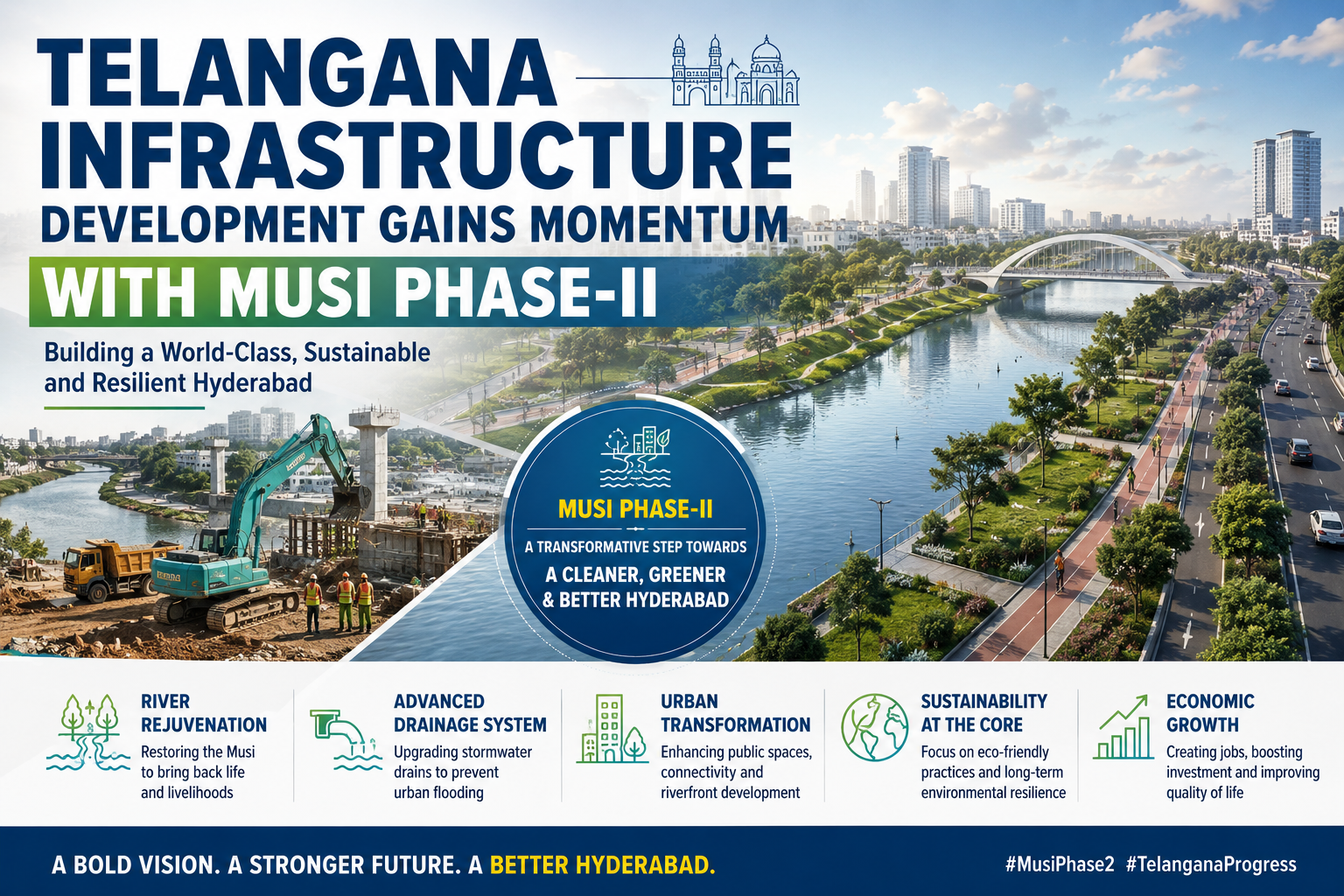
The Telangana Infrastructure Development agenda received a fresh push after Chief Minister Revanth Reddy announced the second phase of the Musi River rejuvenation.
The project unveiled a series of infrastructure initiatives aimed at accelerating urban growth in Hyderabad and surrounding regions.
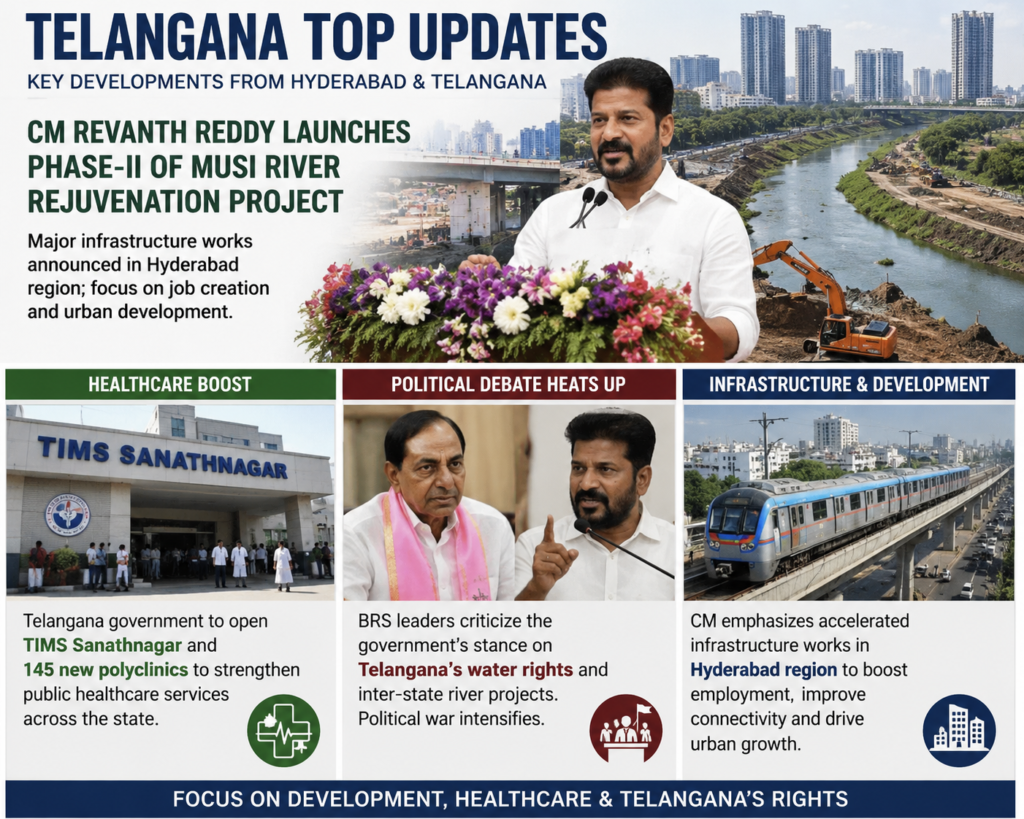
The government also outlined plans to strengthen public healthcare through the opening of TIMS Sanathnagar and a network of 145 new polyclinics across the state.
Meanwhile, political discussions intensified over Telangana’s water rights and inter-state river management issues.
Why This Matters
Infrastructure and healthcare remain central to Telangana’s long-term development strategy.
Large-scale urban projects are expected to improve civic infrastructure, enhance environmental sustainability, and support economic activity.
ALSO READ: ₹1500 CRORE MALKAJGIRI DEVELOPMENT PROJECTS LAUNCHED
Healthcare investments are equally significant as the state seeks to expand access to affordable medical services and reduce pressure on major government hospitals.
The developments also come at a time when water management has emerged as a key political and policy issue in southern India.
Background Context
The Musi River has long been at the center of discussions surrounding Hyderabad’s urban planning and environmental management.
Over the years, concerns regarding pollution, encroachments, and flood management have prompted calls for comprehensive restoration efforts.
The first phase of the Musi rejuvenation initiative focused on planning, cleanup measures, and infrastructure development.
The newly announced Phase-II is expected to continue efforts aimed at improving river health and surrounding urban ecosystems.
In parallel, Telangana has steadily expanded its public healthcare network through hospitals, diagnostic centers, and specialized medical institutions.
Industry Impact
The latest infrastructure announcements could generate opportunities across construction, engineering, urban planning, and related sectors.
Large-scale civic projects often create demand for contractors, consultants, technology providers, and skilled labor.
Government officials have emphasized that infrastructure expansion can contribute to employment generation while supporting Hyderabad’s growing urban population.
Healthcare investments may also stimulate demand for medical professionals, support staff, pharmaceutical services, and healthcare technology providers.
Local Relevance
For Hyderabad residents, the Musi River project carries implications for environmental quality, flood resilience, and urban development.
Improvements to public infrastructure could influence transportation, housing, and commercial growth in several parts of the city.
The proposed healthcare expansion is expected to benefit residents by increasing access to medical services through additional hospitals and neighborhood-level polyclinics.
The developments reinforce Hyderabad’s position as one of India’s fastest-growing metropolitan regions.
Political Debate Over Water Rights
Alongside development announcements, Telangana’s water rights have once again become a major political issue.
Leaders from the Bharat Rashtra Samithi (BRS) have criticized the government’s approach to inter-state river projects and water-sharing matters.
Water management remains a politically sensitive topic due to its direct impact on agriculture, drinking water supplies, and regional development.
The debate highlights the continuing importance of river resources in shaping policy discussions across Telangana and neighboring states.
Comparison With Previous Developments
Successive Telangana governments have prioritized infrastructure expansion as a key pillar of economic growth. Previous initiatives focused on road networks, irrigation projects, urban mobility, and healthcare modernization.
The current announcements build upon those efforts by combining environmental restoration, healthcare expansion, and urban development within a broader growth framework.
As Hyderabad continues to expand, integrated planning initiatives such as the Musi project are increasingly viewed as critical to sustainable urban management.
Conclusion
The latest round of Telangana Infrastructure Development initiatives signals the state’s continued focus on urban modernization, environmental restoration, and public healthcare expansion.
With Phase-II of the Musi River project, the launch of TIMS Sanathnagar, and plans for 145 new polyclinics, the government aims to address both immediate public needs and long-term development goals.
At the same time, ongoing debates over water rights are likely to remain an important political issue in the months ahead.
8. Key Takeaways
- Revanth Reddy announced Phase-II of the Musi River rejuvenation project.
- Major infrastructure projects are being launched across the Hyderabad region.
- The government aims to boost employment through development initiatives.
- TIMS Sanathnagar is set to strengthen Telangana’s healthcare network.
- Plans are underway to establish 145 new polyclinics statewide.
- Water rights and inter-state river projects remain politically sensitive issues.
- BRS leaders have criticized the government’s position on water-sharing matters.