




PM Modi Set to Overtake Nehru’s Record as India’s Longest-Serving Continuously Elected Prime Minister
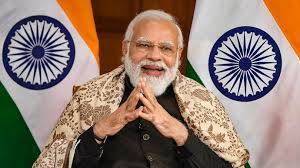
Prime Minister Narendra Modi is on course to achieve a significant milestone in India’s political history by becoming the country’s longest-serving Prime Minister to remain in office through consecutive electoral mandates.
The achievement will see him surpass the record previously held by India’s first Prime Minister, Jawaharlal Nehru.
Since taking office on May 26, 2014, Modi has led the Bharatiya Janata Party (BJP) to three successive victories in the 2014, 2019, and 2024 Lok Sabha elections.
As a result, he has maintained an uninterrupted tenure in office, reflecting sustained electoral success and continued public support across multiple election cycles.
With more than 4,399 consecutive days as Prime Minister, Modi is set to establish a new benchmark for continuous service secured through democratic elections.
The milestone underscores his enduring presence in Indian politics and the BJP’s ability to retain a national mandate over an extended period.
While Jawaharlal Nehru remains India’s longest-serving Prime Minister overall, having led the nation from 1947 until his passing in 1964, Modi’s accomplishment carries a distinct significance.
Unlike Nehru’s tenure, which began in the immediate post-Independence era, Modi’s record has been built through repeated electoral victories in a highly competitive and mature democratic landscape.
The development marks another notable chapter in India’s democratic journey, highlighting the evolving nature of electoral politics and leadership longevity in the world’s largest democracy.
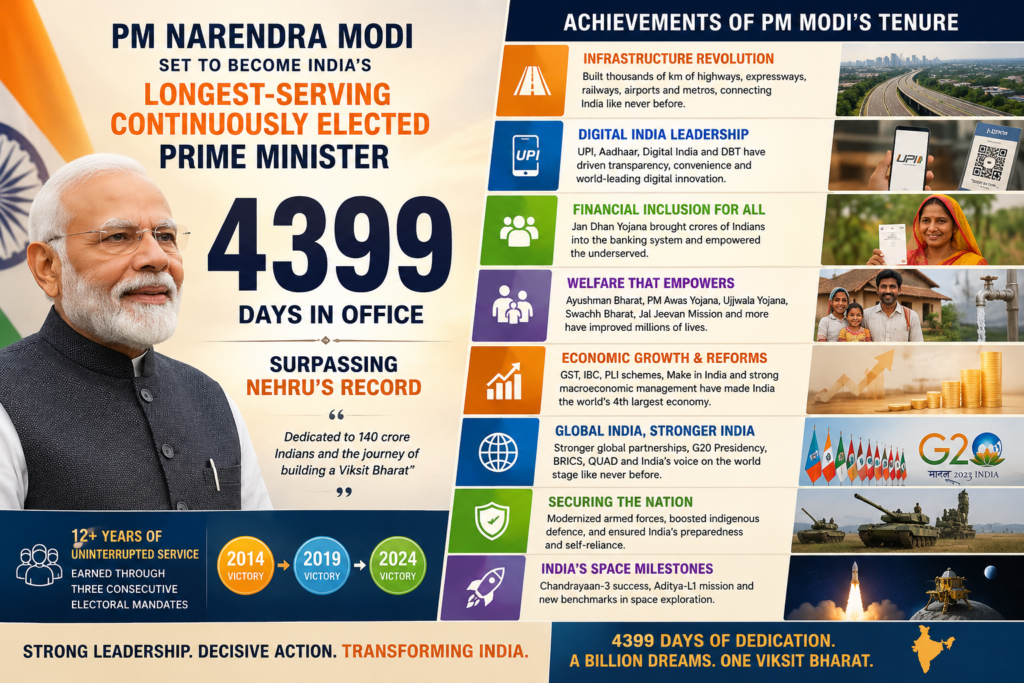
One of the most significant aspects of the PM Modi longest-serving continuously elected Prime Minister era has been the government’s focus on infrastructure development.
India has witnessed rapid expansion of highways, expressways, airports, railway networks, ports, and metro systems. Flagship initiatives such as Bharatmala, Sagarmala, Vande Bharat trains, and dedicated freight corridors have transformed connectivity across the country.
Digital governance has emerged as another hallmark of Modi’s tenure.
Through the Digital India initiative, the government accelerated digitization across sectors.
The Unified Payments Interface (UPI) revolutionized digital transactions and positioned India as a global leader in real-time payments.
- Aadhaar integration and Direct Benefit Transfer (DBT) mechanisms have improved welfare delivery and reduced leakages in government schemes.
- Financial inclusion has also been a major achievement.
- The Pradhan Mantri Jan Dhan Yojana brought hundreds of millions of citizens into the formal banking system.
- Combined with digital platforms and welfare transfers, the initiative significantly expanded access to financial services among rural and economically disadvantaged populations.
- The Modi government has also launched several large-scale welfare programmes.
- Ayushman Bharat expanded healthcare coverage for millions of families, while PM Awas Yojana focused on affordable housing.
- Swachh Bharat Mission aimed to improve sanitation infrastructure nationwide, and the Jal Jeevan Mission sought to provide tap water connections to rural households.
- The Ujjwala Yojana further enhanced access to clean cooking fuel for women across India.
Economically, Prime Minister Narendra Modi’s tenure has been defined by several major structural reforms aimed at strengthening India’s growth trajectory and improving the business environment.
Key initiatives such as the implementation of the Goods and Services Tax (GST) established a unified indirect taxation system across the country, while the Insolvency and Bankruptcy Code (IBC) introduced a more robust framework for resolving stressed assets and corporate insolvencies.
The government has also focused on boosting domestic manufacturing through initiatives such as the Production-Linked Incentive (PLI) schemes and the Make in India programme, both of which have sought to attract investment, expand industrial capacity, and enhance India’s competitiveness in global supply chains.
On the international front, India’s global profile has risen significantly during Modi’s years in office.
The country has strengthened strategic partnerships with major world powers while expanding engagement with emerging and developing economies. India’s successful presidency of the G20 and its active participation in multilateral platforms including BRICS, QUAD, and the United Nations have reinforced its growing diplomatic influence and international standing.
Defence modernization has remained a central pillar of government policy.
Through the Atmanirbhar Bharat initiative, the administration has emphasized self-reliance in defence manufacturing, leading to increased indigenous production capabilities.
A notable rise in defence exports and focus on domestic development of military equipment has also reduced dependence on imports in several key sectors.
India’s achievements in space exploration have further highlighted the country’s technological progress.
The successful landing of Chandrayaan-3 near the Moon’s south pole marked a historic accomplishment, making India the first nation to achieve such a feat.
The launch and operation of the Aditya-L1 solar mission have also showcased India’s expanding capabilities in scientific research and space technology.
Political analysts view Narendra Modi’s ability to secure three consecutive general election victories as a rare achievement in a nation as diverse and complex as India.
The Bharatiya Janata Party’s extensive organizational network, welfare-focused initiatives, and emphasis on development-oriented governance have contributed significantly to its sustained electoral success.
As Modi prepares to surpass the continuous tenure record set by Jawaharlal Nehru, the milestone is likely to spark renewed discussions about leadership, governance, and the evolution of Indian politics since Independence.
Supporters regard the achievement as a reflection of enduring public confidence and policy continuity, while critics continue to debate the long-term impact of the government’s policies and political approach.
Irrespective of political perspectives, the milestone represents a significant moment in India’s democratic history.
It highlights the importance of sustained electoral mandates and reflects a period of considerable political, economic, technological, and diplomatic transformation in the world’s largest democracy.
Ganesh is a versatile and skilled reporter with the rare ability to cover a broad range of subjects and write about them in an interesting and educational way, without being constrained to a particular subject area, including business, science, and technology, as well as everything in between.