






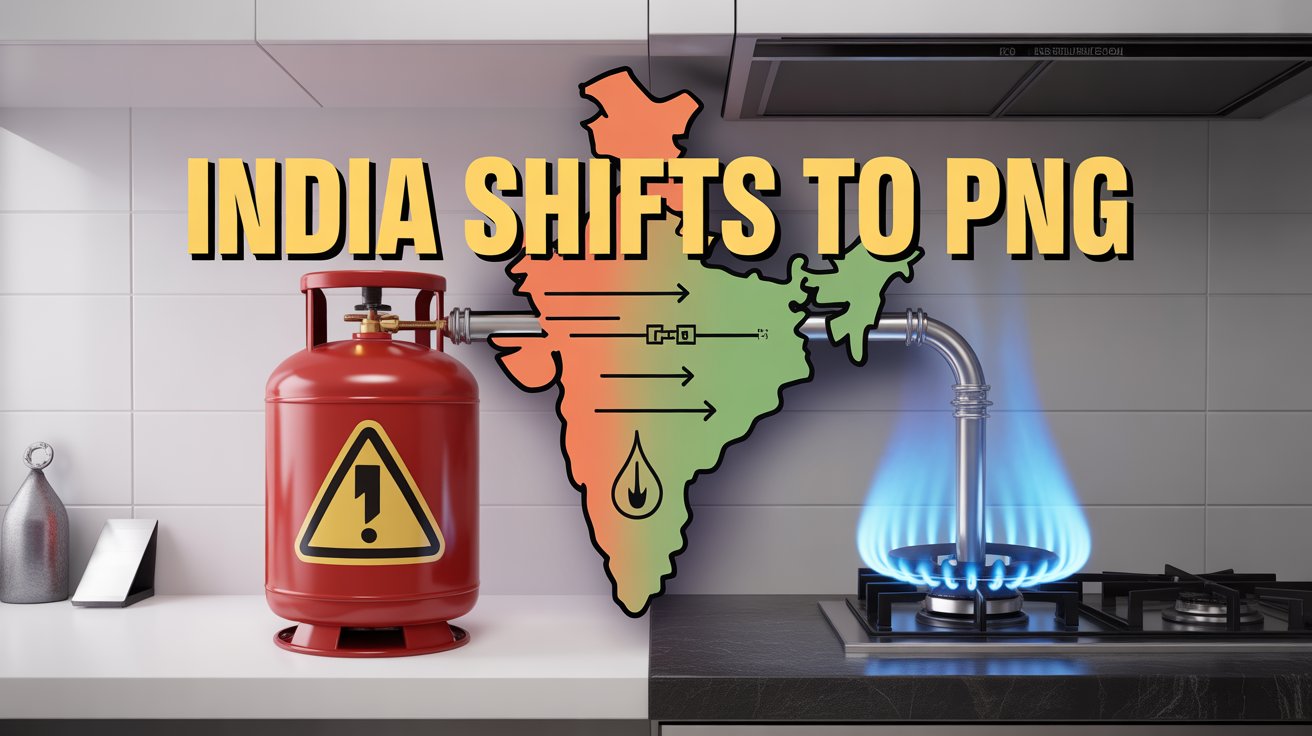
LPG To PNG is Must – Policy aims to reduce import dependence, improve safety, and expand gas infrastructure amid global supply pressures.
India has taken a decisive step toward reshaping household energy consumption by mandating a transition from LPG cylinders to piped natural gas (PNG) in areas where pipeline infrastructure is already available.
The move, driven by concerns over import dependence and global supply disruptions, signals a broader structural shift in the country’s energy strategy.
What the Order Says
Under the new directive:
- Households with access to PNG are required to switch within a specified timeframe (around 3 months)
- Failure to comply may result in discontinuation of LPG cylinder supply
- Housing societies or buildings that delay or block PNG pipeline installation may also face restrictions in LPG supply
The policy effectively prioritizes PNG distribution in urban and semi-urban areas where infrastructure is already in place.
Why the Government Is Acting Now
India’s heavy reliance on LPG imports has made it vulnerable to global disruptions, particularly in regions like West Asia.
Key factors behind the decision include:
- India imports around 60% of its LPG requirement
- Recent geopolitical tensions have strained supply chains
- PNG offers a more stable, domestically manageable distribution system
By shifting households already equipped for PNG, the government aims to redirect LPG supplies to underserved regions, especially rural areas.
Scale of the Challenge
Despite infrastructure availability, adoption has lagged:
- Nearly 60 lakh households have PNG access but continue using LPG
- India has over 33 crore LPG connections, compared to about 1.6 crore PNG users
This gap highlights both the behavioral inertia among consumers and the need for policy enforcement.
PNG vs LPG: Key Differences
- PNG Advantages
- Continuous supply (no refilling required)
- Considered safer—gas disperses quickly in case of leaks
- Eliminates logistics of cylinder storage and delivery
- LPG Limitations
- Dependent on cylinder availability
- Higher logistical costs
- Greater import dependence
- A Larger Energy Transition
Beyond immediate supply concerns, the move reflects a deeper transition:
India is gradually shifting from a “cylinder-based energy system” to a “pipeline-based distribution model.”
This aligns with long-term goals of:
Enhancing energy security
Reducing import exposure
Building urban gas infrastructure
What It Means for Consumers
For households, the shift may bring both convenience and compulsion:
- Short-term inconvenience during transition
- Long-term benefits in safety and uninterrupted supply
- Reduced dependency on booking and waiting for cylinders
However, awareness and infrastructure readiness will play a crucial role in smooth implementation.
Conclusion
The government’s directive marks a significant turning point in India’s domestic energy landscape.
While the transition may face resistance in the short term, it reflects a strategic push toward efficiency, resilience, and modernization of fuel distribution.
The success of this policy will depend not just on enforcement, but also on how effectively consumers adapt to a changing energy ecosystem.
