






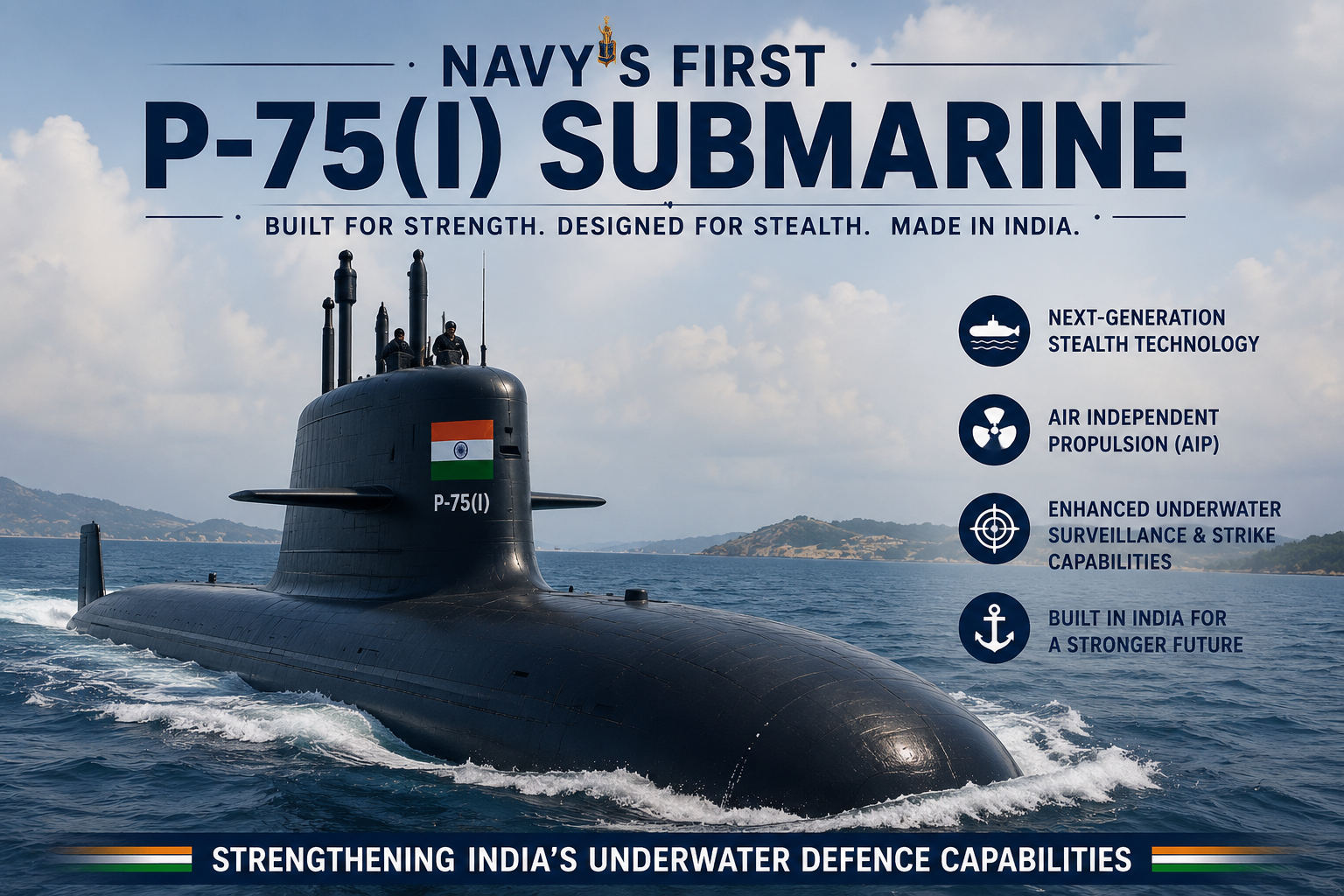
Project 75(I) Submarine to Join Indian Navy Fleet by 2033, Says Outgoing Chief Admiral Tripathi
Project 75(I) submarine is expected to join the Indian Navy fleet by 2033, outgoing Chief of Naval Staff Admiral Dinesh K. Tripathi has announced, providing a significant timeline for one of India’s most ambitious naval modernization programmes.
The induction of the Project 75(I) submarine will mark a major step in strengthening India’s underwater warfare capabilities, enhancing maritime security, and advancing the country’s goal of self-reliance in defence manufacturing.
The announcement comes at a crucial time as India continues to modernize its armed forces and expand its strategic presence in the Indian Ocean Region.

The Project 75(I) submarine programme is widely regarded as a key pillar of the Indian Navy’s future force structure and a critical component of the country’s maritime security strategy.
Advanced Capabilities for Modern Naval Warfare
The Project 75(I) submarine programme aims to build six next-generation conventional submarines equipped with advanced technologies and enhanced combat capabilities.
These submarines will be designed to undertake a wide range of missions, including anti-submarine warfare, anti-surface warfare, intelligence gathering, surveillance operations, and strategic deterrence missions.
One of the most important features of the Project 75(I) submarine will be the incorporation of Air Independent Propulsion (AIP) technology. Unlike conventional diesel-electric submarines that need to surface periodically or use snorkels to recharge their batteries, AIP-equipped submarines can remain submerged for significantly longer periods.
This capability greatly enhances stealth, making them more difficult for adversaries to detect and track.
Defence experts consider AIP technology a major force multiplier that enables submarines to conduct extended patrols and covert operations in strategically sensitive waters.
The Project 75(I) submarine fleet is expected to provide the Indian Navy with a significant operational advantage in the region.
Building on the Success of Project 75(I) Submarine
The Project 75(I) submarine initiative follows the successful implementation of Project 75, under which six Scorpene-class submarines were constructed in India.
Those submarines have already strengthened India’s underwater combat capabilities and provided valuable experience in indigenous submarine construction.
The new Project 75(I) submarine programme seeks to build upon this foundation by introducing more advanced technologies, greater indigenous content, and improved combat systems.
The project is expected to involve extensive collaboration between Indian shipyards and international technology partners under the government’s strategic partnership model.
Officials believe that the knowledge and expertise gained from the earlier submarine programme will help accelerate the development of the new fleet while enhancing India’s domestic defence manufacturing ecosystem.
Strengthening India’s Maritime Security
The induction of the first Project 75(I) submarine by 2033 is expected to significantly boost India’s maritime deterrence capabilities.
The Indian Ocean Region has become increasingly important in global geopolitics, with growing naval activity and strategic competition among major powers.
As a nation heavily dependent on maritime trade and secure sea lanes, India places considerable importance on maintaining a strong and capable navy operations.
The Project 75(I) submarine fleet will help protect national interests, monitor critical maritime routes, and ensure operational readiness in the event of regional security challenges.
Submarines are among the most effective military assets for deterrence due to their ability to operate undetected for extended periods.
The advanced stealth features of the Project 75(I) submarine are expected to enhance the Navy’s ability to conduct surveillance, gather intelligence, and respond swiftly to emerging threats.
Boost to Indigenous Defence Manufacturing
Beyond its military significance, the Project 75(I) submarine programme is expected to deliver substantial economic and technological benefits.
The initiative aligns closely with the government’s ‘Aatmanirbhar Bharat’ vision, which seeks to strengthen domestic defence production and reduce reliance on imported military equipment.
The construction of the Project 75(I) submarine fleet is expected to generate employment opportunities, encourage technology transfer, and promote the growth of India’s defence industrial base.
Indian companies are likely to benefit from participation in manufacturing, engineering, electronics, and systems integration activities associated with the project.
Industry experts believe the programme will contribute to the development of advanced technological capabilities that could support future indigenous submarine and naval projects.
A Major Milestone Ahead
Admiral Tripathi’s projection that the first Project 75(I) submarine will join the fleet by 2033 highlights both the scale and complexity of modern submarine construction.
Such programmes require years of planning, design, technology integration, testing, and sea trials before operational deployment.
Nevertheless, the Project 75(I) submarine remains one of the Indian Navy’s most important modernization initiatives.
Its successful induction will not only enhance India’s underwater warfare capabilities but also demonstrate the country’s growing expertise in advanced defence manufacturing.
As India continues to strengthen its maritime posture in an increasingly competitive strategic environment, the Project 75(I) submarine programme is expected to play a pivotal role in safeguarding national interests, ensuring regional stability, and preparing the Indian Navy for future challenges.
With the first submarine expected by 2033, the programme represents a significant step toward building a more capable, technologically advanced, and self-reliant naval force.

Ganesh is a versatile and skilled reporter with the rare ability to cover a broad range of subjects and write about them in an interesting and educational way, without being constrained to a particular subject area, including business, science, and technology, as well as everything in between.