







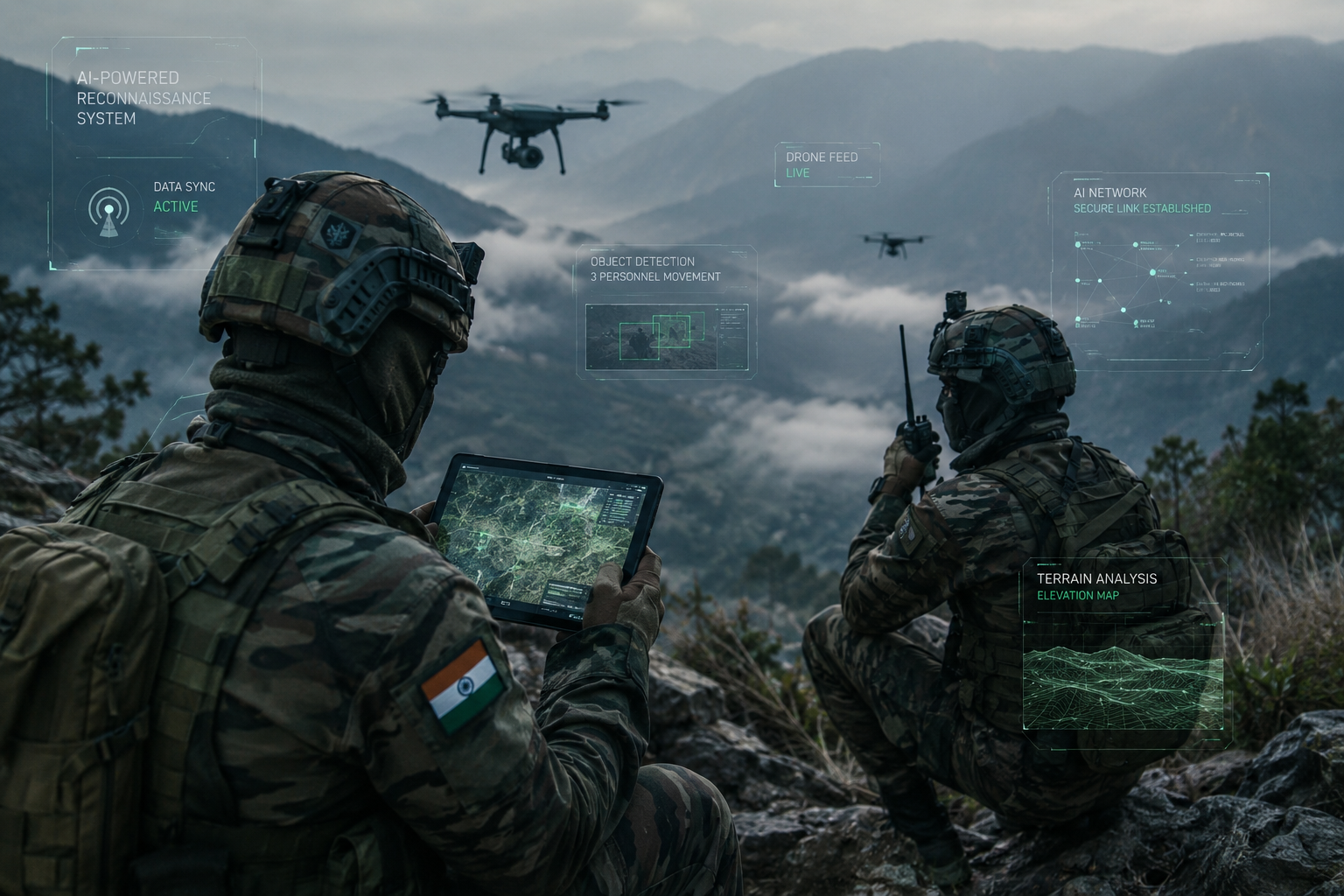
Indian Army AI Platforms has taken a significant step toward modern warfare with the development of two advanced artificial intelligence systems — Kautilya and Q-Force.
These new Indian Army AI Platforms are designed to strengthen military intelligence, improve battlefield awareness, and support faster operational decisions in high-risk environments.
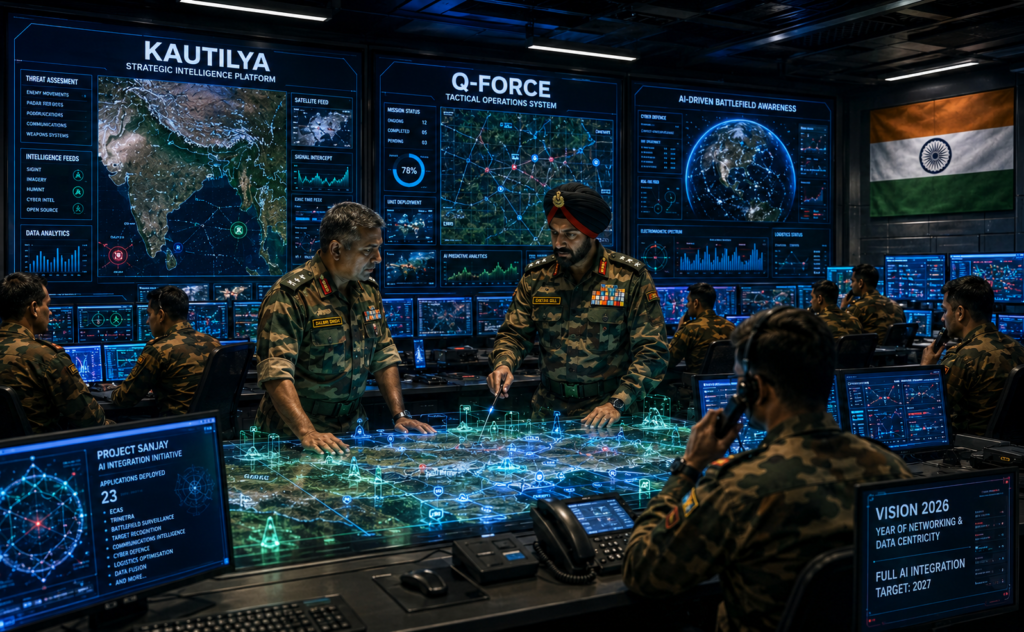
The Indian Army has integrated these platforms into its broader push toward artificial intelligence and data-driven military operations.
The Army has identified 2026 as a pivotal year focused on networking and data centricity, while complete AI integration across operational systems is expected by 2027.
Earlier deployments of AI technologies during Operation Sindoor included 23 advanced applications such as ECAS and TRINETRA, developed under Project SANJAY.
These systems were used to enhance surveillance, intelligence gathering, and operational coordination, highlighting the military’s increasing reliance on AI-enabled warfare capabilities.
The move reflects India’s growing focus on integrating cutting-edge technology into national defence systems at a time when global militaries are rapidly adopting AI-powered capabilities.
According to reports, the Indian Army AI Platforms are being developed to process massive volumes of battlefield data, monitor threats, and assist commanders with real-time analysis.
The systems are expected to improve coordination, surveillance, and predictive intelligence across military operations.
What Are Kautilya and Q-Force?
The platform named Kautilya is reportedly focused on advanced strategic intelligence and operational planning.
Inspired by the ancient Indian strategist Chanakya, also known as Kautilya, the system is intended to help military leadership assess threats, study enemy movement patterns, and generate actionable insights from complex data.
Meanwhile, Q-Force has been designed to support tactical battlefield operations.
It is expected to assist troops with faster information-sharing, situational awareness, and intelligent monitoring during missions.
Together, these Indian Army AI Platforms could transform how military information is collected, analyzed, and used during operations
Key Features of the Indian Army AI Platforms
Some of the major capabilities expected from the AI systems include:
- Real-time battlefield data analysis
- Faster threat detection and response
- AI-assisted operational planning
- Improved surveillance and intelligence gathering
- Enhanced communication between units
- Predictive assessment of security risks
Defence experts believe such systems can reduce response time during critical situations and improve operational efficiency in sensitive border regions.
Artificial intelligence is becoming a decisive factor in future warfare, and India’s military modernization is now moving rapidly in that direction.
Why These AI Platforms Matter
The development of these Indian Army AI Platforms comes amid increasing geopolitical tensions and rising investments in military technology worldwide.
Nations across the globe are integrating AI into defence systems for cyber security, autonomous surveillance, intelligence processing, and combat support.
For India, adopting AI-driven defence infrastructure could provide several strategic advantages:
- Better border monitoring
- Faster military decision-making
- Improved coordination during emergencies
- Reduced dependence on manual intelligence analysis
The initiative also aligns with the government’s broader push toward indigenous defence innovation and self-reliance under the “Make in India” vision.
Growing Role of AI in Defence
Artificial intelligence is increasingly becoming central to modern defence operations. AI tools are now used globally for drone monitoring, cyber defence, satellite intelligence, logistics management, and combat simulations.
The introduction of Indian Army AI Platforms such as Kautilya and Q-Force signals that India is positioning itself to compete in the next generation of technology-driven warfare.
While the systems are still evolving, experts say their successful deployment could significantly strengthen India’s defence preparedness in the years ahead.