




New Delhi: Centre invites organisations to strengthen district-level de-addiction services
The Ministry of Social Justice & Empowerment, Government of India, has invited Expression of Interest-cum-Proposals from eligible organisations for setting up and running District De-Addiction Centres (DDACs) under the National Action Plan for Drug Demand Reduction (NAPDDR).
The notice, dated August 4, 2026, covers 315 identified GAP Districts across the country, with the Ministry retaining the right to modify the district list by adding or removing districts depending on requirements on the ground.
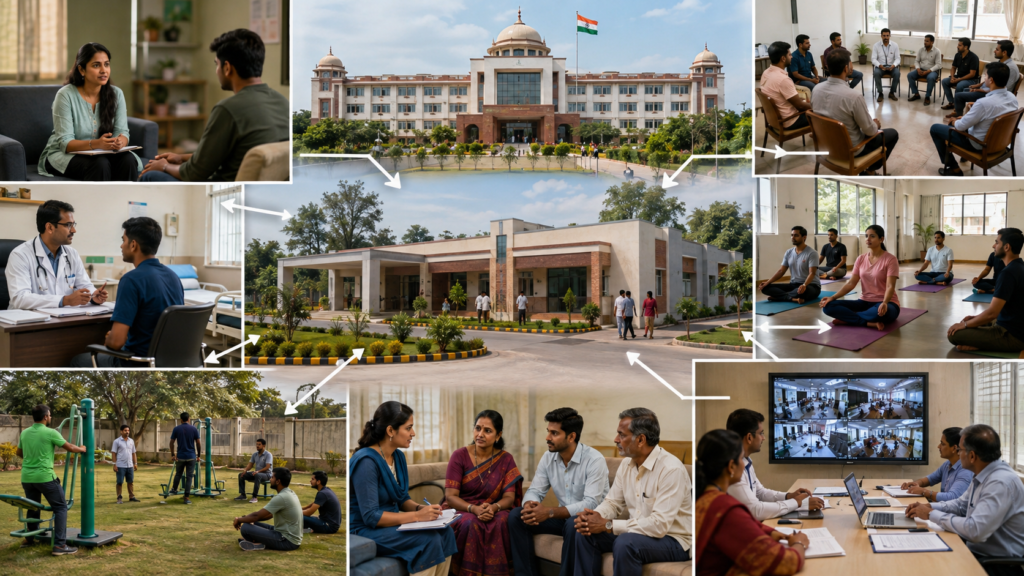
The initiative seeks to create accessible district-level facilities offering treatment, rehabilitation, counselling and other support services for people affected by drug dependence.
17 Telangana districts included in the list
Telangana has been given a significant presence in the list of identified districts.
The 17 districts included are:
- Hyderabad
- Jagitial
- Jayashankar Bhupalapally
- Kamareddy
- Kumuram Bheem Asifabad
- Mahabubabad
- Mancherial
- Mulugu
- Nagarkurnool
- Narayanpet
- Nirmal
- Nizamabad
- Peddapalli
- Rajanna Sircilla
- Siddipet
- Suryapet
- Warangal
The Telangana districts appear as entries 261 to 277 in Annexure-I of the government notice.
The inclusion of Hyderabad and several other major and geographically diverse districts potentially creates opportunities for experienced de-addiction organisations to participate in the programme, subject to the eligibility and selection conditions prescribed by the Ministry.
What is a District De-Addiction Centre?
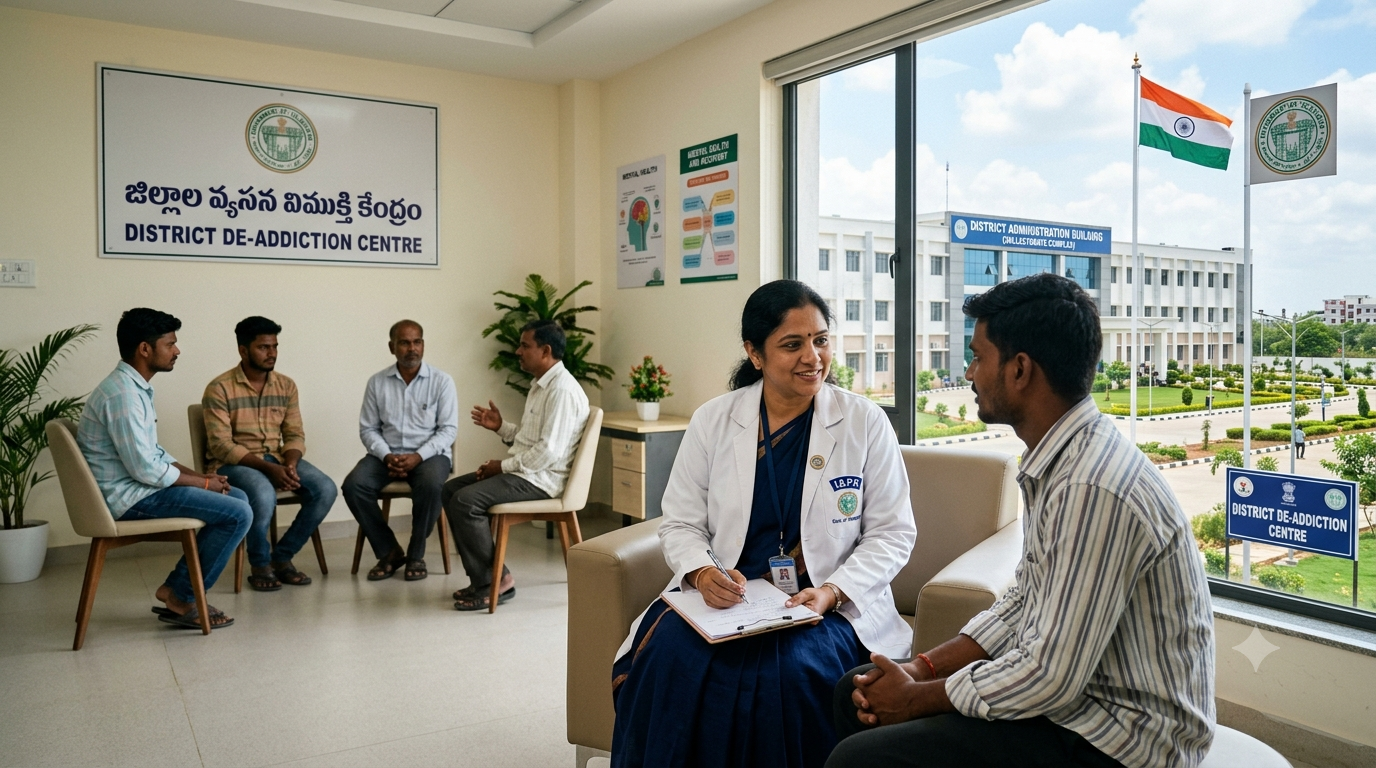
The DDAC model is designed as a comprehensive district-level de-addiction facility, bringing together services previously provided through different interventions, including IRCA, ODIC and CPLI.
The centres are expected to provide treatment and rehabilitation services along with counselling and other support facilities.
The Government’s objective is to preferably establish a DDAC at the district headquarters or at another suitably accessible location, particularly where the district administration can provide suitable rent-free accommodation.
Where the district administration cannot provide an appropriate facility, an eligible NGO or voluntary organisation may provide premises itself, subject to the requirement that the accommodation is provided on a rent-free basis.
Two-year experience is a key eligibility condition
One of the most significant provisions in the notice concerns the previous experience of the applicant organisation.
Organisations eligible to apply include those already running:
- MoSJE-supported IRCA facilities;
- State Government-supported de-addiction centres;
- Government hospitals; or
- privately run de-addiction centres.
The organisation generally must have been operating an IRCA or de-addiction centre for at least two years in the same State/UT from the date of the call for proposals.
The notice provides a possible relaxation of this condition for certain non-profit government-run hospitals.
Rent-free premises are mandatory
The Government has placed considerable emphasis on the availability of suitable accommodation.
The preferred arrangement is for the District Administration to provide rent-free premises, preferably at the district headquarters or another accessible location.
If the District Administration does not provide accommodation, an eligible NGO may apply using its own premises.
However, the notice makes it clear that the NGO cannot seek rent for the premises in such a case. The provision refers to building maintenance rather than payment of rent.
This makes the availability of suitable premises a crucial consideration before an organisation prepares its proposal.
Minimum infrastructure requirements
The DDAC is expected to be a substantial facility rather than a small counselling office.
For a centre catering to 15 patients, the minimum built-up area specified is:
| Location | Minimum area |
|---|---|
| Metro | 3,000 sq ft |
| Small town/village | 4,000 sq ft |
For a centre catering to 30 patients, the requirement increases to:
| Location | Minimum area |
|---|---|
| Metro | 4,000 sq ft |
| Small town/village | 5,000 sq ft |
The guidelines indicate approximately 2,000 sq ft for the Treatment-cum-Rehabilitation Centre, around 700 sq ft for Drop-In Centre facilities, and around 300 sq ft for CPLI-related facilities.
Centres must provide medical, counselling and rehabilitation facilities
The prescribed infrastructure includes adequate ventilation, lighting, cleanliness, water supply and basic patient safety.
The centres must also provide:
- waiting space with seating for at least five people;
- consultation and physical examination rooms;
- facilities for storing medicines, linen and patient records;
- private spaces for individual counselling;
- group therapy facilities;
- re-educative sessions;
- family classes;
- recreational facilities;
- a separate Drop-In Centre;
- recreation, counselling and medical rooms; and
- a project room for CPLI activities, including interviewing facilities.
The Ministry has also reserved the right to modify the prescribed standards when necessary, with stakeholders and organisations to be informed of such changes.
Government monitoring will operate at three levels
The DDACs will not function as independent NGO-run facilities without government oversight.
The notice provides for a three-tier monitoring mechanism:
State level:
A State-level Steering and Monitoring Committee headed by the Chief Secretary, meeting quarterly.
District level:
A committee headed by the District Collector/Deputy Commissioner, with monthly meetings and mandatory quarterly inspections.
Block level:
A committee headed by the Block Development Officer, with monthly meetings and mandatory monthly inspections.
These committees will review the functioning and performance of DDACs and assess whether the expected deliverables are being achieved.
Government assistance to be released in two instalments
The notice provides for Government assistance under the scheme.
According to the document, the Ministry’s Project Screening Committee will select eligible organisations for establishing and operating DDACs and recommend release of funds in two instalments.
The organisation becomes eligible to receive Government assistance under the scheme from the date of approval by the competent authority.
However, the 17-page notice itself does not specify a single total funding amount or fixed project-cost ceiling. Therefore, prospective applicants should refer to the applicable NAPDDR financial norms before preparing a detailed financial proposal rather than assuming a particular grant amount.
Dedicated account and PFMS compliance required
Organisations receiving DDAC funds will have to maintain a separate dedicated account for the project.
The account must be:
- maintained in the name of the NGO/organisation;
- registered on the Public Financial Management System (PFMS); and
- implemented through the EAT Module.
This indicates that Government assistance will be subject to financial monitoring and prescribed fund-management procedures.
Districts without existing facilities get preference
The Ministry has indicated that preference will be given to districts that do not already have an IRCA or DDAC facility.
The selection priority broadly places emphasis on:
- DDACs proposed to be run by the District Administration;
- cases where the District Administration provides rent-free accommodation and an eligible NGO operates the centre; and
- eligible NGOs providing their own rent-free premises where the District Administration cannot provide suitable accommodation.
This makes the existing de-addiction infrastructure in a proposed district an important factor for applicants.
Applications only through e-Anudaan
The Ministry has specifically warned organisations against submitting physical applications.
The notice states that hard-copy/physical DDAC applications will not be considered and that organisations must apply online through the Ministry’s e-Anudaan portal.
The notice also requests that the portal remain open throughout the year for new DDAC projects from GAP Districts, although the district list itself remains subject to change by the Ministry.
What organisations should check before applying
For organisations in Telangana and other listed states, the practical eligibility checklist begins with five questions:
1. Does the organisation have at least two years of qualifying de-addiction-centre experience in the relevant State/UT?
2. Is the proposed district included in the current GAP District list?
3. Is suitable rent-free accommodation available?
4. Does the premises meet the prescribed area and infrastructure requirements?
5. Can the organisation comply with PFMS, EAT, monitoring, reporting and other Government requirements?
Only after these basic questions are satisfied does it make sense to proceed with preparation of the detailed DDAC proposal.
A significant opportunity for strengthening India’s anti-drug infrastructure
The DDAC initiative represents an attempt to strengthen the country’s district-level response to drug dependence by combining treatment, rehabilitation, counselling and community-oriented services within a structured district framework.
For Telangana, the inclusion of 17 districts makes the notification particularly significant. However, the opportunity comes with substantial eligibility, infrastructure and compliance requirements.
The Government’s emphasis on experienced organisations, rent-free premises, prescribed infrastructure and multi-level monitoring indicates that the programme is designed not merely to fund a new facility, but to establish structured and accountable de-addiction services at the district level.
With applications restricted to the e-Anudaan platform, organisations interested in participating will need to verify their eligibility and prepare their proposals in accordance with the NAPDDR requirements before submission.