







Photosynthesis in Mouse Eye Cells Opens a New Frontier in Eye Medicine
In a groundbreaking scientific achievement, researchers have successfully demonstrated photosynthesis in mouse eye cells, using biological material extracted from spinach leaves.
The study, published in the journal Cell, could pave the way for a completely new class of treatments for dry eye disease and other eye disorders.

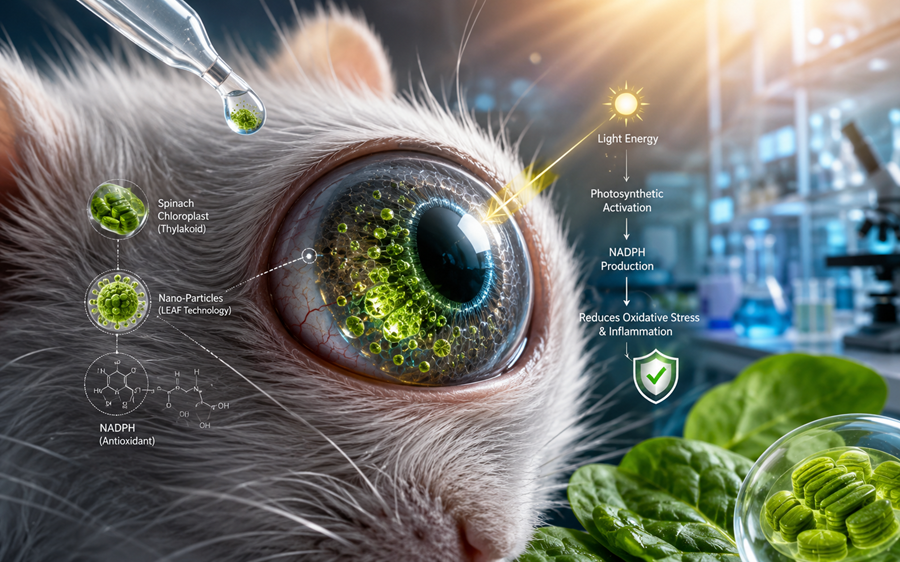
The research was led by scientists from the National University of Singapore, who developed innovative eye drops containing microscopic structures taken from spinach chloroplasts, the cellular machinery responsible for photosynthesis in plants.
Once applied to mouse eyes, these structures used ambient light to generate beneficial antioxidant molecules that helped reduce inflammation and repair tissue damage.
How Photosynthesis in Mouse Eye Cells Works
The treatment uses a technology called LEAF (Light-Reaction Enriched Thylakoid NADPH Foundry).
Researchers extracted photosynthetic membranes known as thylakoids from spinach leaves and packaged them into tiny nanoparticles suitable for medical use.
Under normal light exposure, these particles produce NADPH, a naturally occurring antioxidant that protects cells from oxidative stress. In dry eye disease, oxidative stress and inflammation damage the eye’s surface, leading to irritation, redness, and discomfort.
Simplified Process
- Spinach chloroplast structures are isolated.
- They are converted into nano-sized therapeutic particles.
- Eye drops deliver the particles to corneal cells.
- Natural light activates photosynthetic reactions.
- Antioxidants are produced directly in the eye.
- Inflammation and tissue damage are reduced.
Analytical Breakdown of the Discovery
Treatment Flow
| Stage | Biological Action | Expected Benefit |
|---|---|---|
| Spinach Extraction | Photosynthetic structures isolated | Provides light-sensitive machinery |
| Nano-Encapsulation | Structures protected in nanoparticles | Safe delivery to eye tissue |
| Light Activation | Ambient light triggers reactions | Continuous therapeutic activity |
| NADPH Production | Antioxidants generated | Reduces oxidative damage |
| Tissue Recovery | Cellular repair promoted | Improved eye health |
Why This Matters
Dry eye disease affects hundreds of millions of people worldwide and is becoming increasingly common due to:
- Increased screen time
- Aging populations
- Air pollution
- Contact lens use
- Autoimmune disorders
Current treatments largely focus on symptom relief. The new approach aims to address the underlying cellular damage itself.
Researchers Borrow Nature’s Most Powerful Energy System
Photosynthesis is normally associated with plants, algae, and certain bacteria. It converts sunlight into usable biochemical energy.
6CO_2 + 6H_2O + light \rightarrow C_6H_{12}O_6 + 6O_2
Instead of producing sugars as plants do, the scientists adapted part of this natural process to generate protective molecules inside eye tissue.
The result is a novel form of “light-powered medicine” that works using the same environmental light people encounter every day.
“This breakthrough expands the role of light in the eye from simply enabling vision to actively supporting tissue repair and metabolic health.”
Did the Mouse Eyes Turn Green?
One of the most common questions surrounding the experiment is whether the mice developed green-colored eyes.
The answer is no.
Researchers used extremely low concentrations of chlorophyll-containing material, enough to trigger the desired biochemical reactions but far below the level required to visibly alter eye color.
Scientists reported no noticeable green coloration during the study.
Challenges Before Human Use
Although the results are promising, the technology remains in the preclinical stage.
Researchers must still determine:
- Long-term safety in larger animals
- Stability of the photosynthetic particles
- Potential side effects in humans
- Regulatory approval requirements
- Manufacturing scalability
Human clinical trials are expected to be the next major milestone if safety studies continue to show positive results.
The Bigger Picture
The success of photosynthesis in mouse eye cells represents more than just a new treatment for dry eye disease.
It demonstrates how biological systems from entirely different species can be adapted to solve medical problems.
Scientists believe this nature-inspired biotechnology could eventually be applied to other tissues and diseases where oxidative stress plays a major role.
If successful in humans, photosynthesis in mouse eye cells may become the foundation for a new generation of light-powered therapies that merge plant biology with modern medicine.