








As Micron Opens Landmark ATMP Facility in Gujarat
India has taken a decisive leap in its semiconductor ambitions as Micron Technology commenced operations at its advanced memory Assembly, Testing, Marking and Packaging (ATMP) facility in Sanand, Gujarat.
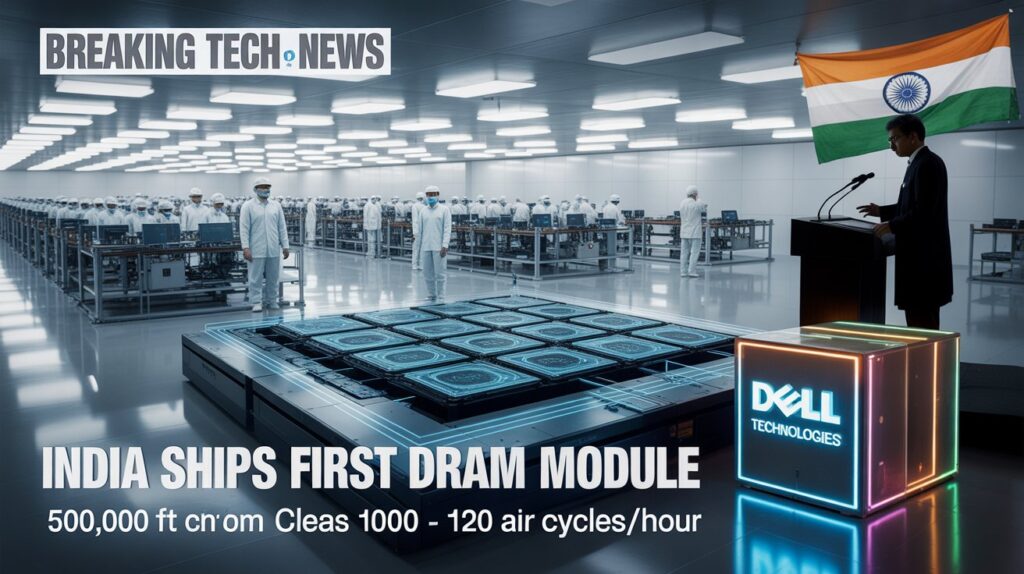
The plant has already shipped its first finished DRAM module to Dell Technologies, marking the country’s formal entry into high-end semiconductor assembly and testing.
The facility was inaugurated by Narendra Modi, making it India’s first advanced memory ATMP site and a cornerstone in the nation’s push to build a resilient semiconductor ecosystem.
Largest Raised-Floor Semiconductor Clean Room in the World
At the heart of the Sanand facility lies a 500,000-square-foot raised-floor clean room — the largest single semiconductor assembly clean room of its kind globally.
The structure has been specially engineered to withstand Gujarat’s soil and climatic conditions, particularly addressing moisture-related risks that can compromise sensitive chip manufacturing processes.
The clean room is classified as Class 1000, meaning it permits no more than 1,000 airborne particles per cubic metre.
HIGHLIGHTS
India has shipped its first advanced DRAM module, as Micron begins operations at its ₹2.7 billion ATMP facility in Gujarat.
🔹 500,000 sq ft clean room – largest of its kind
🔹 Class 1000 environment (ultra-pure air standards)
🔹 Target: Up to 1 billion chips annually by 2027From design hub to manufacturing force — India’s semiconductor ambition just became reality.
Is India ready to become a global chip powerhouse?
Historic Tech Milestone for India!
To maintain such ultra-pure conditions, air inside the facility is circulated approximately 120 times per hour — a standard that significantly exceeds pharmaceutical clean room norms.
This level of environmental control is critical for protecting delicate integrated circuits and gold bonding wires, some of which are thinner than fractions of a human hair.
Advanced Memory Manufacturing: DRAM and NAND Operations
The Sanand plant focuses on assembling and testing two key memory technologies:
- DRAM (Dynamic Random Access Memory) – Volatile memory used as primary working memory in computers, smartphones, servers, and data centres.
- NAND Flash Memory – Non-volatile storage used in solid-state drives (SSDs), smartphones, and embedded systems.
The facility operates on a wafer-in to finished-product-out model. Silicon wafers sourced from Micron’s global fabrication plants are transported to India, where they undergo thinning, dicing into individual chips, assembly, testing, and mounting onto modules. After rigorous quality checks, the final products are shipped to customers.
The total planned investment for the project across two phases stands at $2.7 billion. Production is expected to reach tens of millions of integrated circuits in its initial phase, with scaling plans targeting close to one billion units annually by 2027. While exports will constitute a significant share of output, domestic demand from India’s growing electronics sector will also be served.
Skilled Workforce and Global-Grade Technology Integration
The facility currently employs approximately 1,300 professionals, nearly half of whom are fresh engineering graduates from Gujarat and neighbouring states. To build specialised semiconductor expertise, tailored academic curricula were developed in collaboration with universities.
Selected recruits underwent three to six months of intensive hands-on training at Micron facilities in Malaysia and Singapore, ensuring global standards of operational excellence from day one.
The plant integrates advanced automation systems, AI-driven factory intelligence, and sophisticated yield engineering tools that match international benchmarks. Initial shipments include DRAM modules for Dell Technologies, with additional supplies planned for major technology players such as Asus and Qualcomm.
Strategic Boost to India’s Semiconductor Ecosystem
The Sanand ATMP facility represents more than a manufacturing unit — it signals India’s transition from being primarily a semiconductor design hub to becoming an active participant in advanced memory packaging and testing.
This development aligns with India’s broader objective of strengthening its electronics manufacturing ecosystem, reducing import dependence in critical technologies, and integrating deeper into global semiconductor supply chains.
As geopolitical shifts and supply chain disruptions continue to reshape the global chip industry, India’s entry into advanced memory assembly and testing positions it as an emerging and credible player in the semiconductor value chain.
With large-scale investment, world-class infrastructure, skilled manpower, and global partnerships now in place, the Sanand facility could become a foundational pillar in India’s ambition to evolve into a major semiconductor manufacturing destination.
