






The Fear of Flying vs the Reality of Road Travel
Imagine boarding an aircraft at Hyderabad’s Rajiv Gandhi International Airport.
As the plane accelerates down the runway and lifts into the sky, your heart starts racing.
You grip your armrest, watch the clouds outside and wonder: What if something goes wrong thousands of feet above the ground?
Now imagine travelling the same distance by car. You sit comfortably, watch the road and feel that you are in control.
But here is the uncomfortable question: Is Flying Safer Than Driving, or does driving simply feel safer because we are more familiar with it?
The answer becomes fascinating when we examine the data.
- According to the International Air Transport Association (IATA), the global commercial aviation industry recorded 51 accidents across 38.7 million flights in 2025.
- Eight of those accidents were fatal.
- These numbers demonstrate that aviation accidents are real, even though they are rare. Source: IATA’s 2025 Annual Safety Report.
Yet the real story emerges when we compare transport risks using a common measurement rather than simply counting accidents.
What conspiracy theories claim

1. The TWA Flight 800 controversy
In 1996, TWA Flight 800 exploded over the Atlantic Ocean, killing all 230 people aboard.
Some conspiracy theories claimed it had been hit by a missile or destroyed deliberately.
The official investigation concluded that a center fuel-tank explosion caused the crash, with an electrical fault associated with the FQIS considered the most likely ignition source.

2. Aircraft manufacturers hide defects
Some theories claim airlines or manufacturers conceal technical problems to avoid financial losses. There have been genuine cases of defects requiring corrective action, but a defect or recall alone does not prove a deliberate cover-up.

3. Pilots cannot always trust fuel readings
This concern has a factual basis: fuel-quantity indications can be inaccurate or fail.
Aviation authorities have issued requirements for fuel-quantity verification on particular aircraft.
However, an inaccurate reading does not automatically mean an aircraft will run out of fuel; crews have procedures for handling such faults.
So, is it safe to fly?
The honest answer is that flying is not risk-free, but commercial aviation uses multiple layers of protection: aircraft certification, scheduled maintenance, crew training, operational procedures and regulatory oversight.
- The TWA 800 case is particularly relevant because it demonstrates that a real technical safety problem can exist without validating theories of deliberate sabotage.
To prove that flying is not risk-free, we need to distinguish three things:
- Documented accidents
- Measurable statistical risk, and
- The possibility of technical failure.
Commercial aviation is among the safest forms of long-distance transport, but it cannot guarantee zero risk.
That conclusion is based on accident records and aviation safety data, not conspiracy theories.
1. Statistical proof: accidents still happen
The International Air Transport Association (IATA) published its 2025 Annual Safety Report on March 9, 2026. Its findings provide a measurable basis for assessing aviation risk.
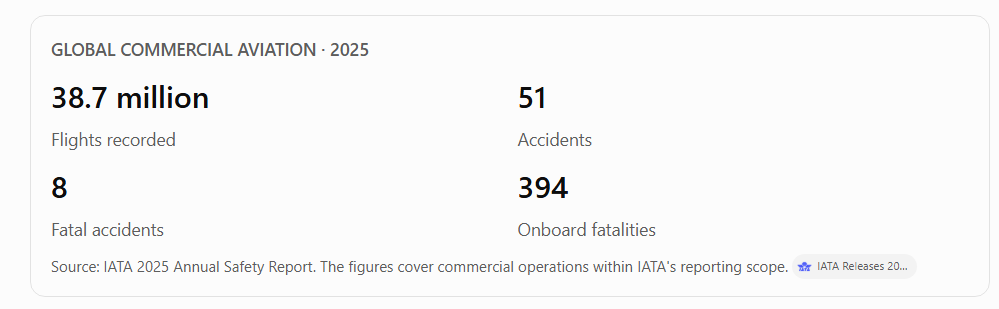
- In other words, accidents and fatal accidents are real, documented events.
- However, the 51 accidents include different levels of severity, and they do not mean that 51 flights crashed catastrophically.
- IATA reported an overall accident rate of approximately one accident per 760,000 flights in 2025. This is evidence of low risk, not zero risk.
2. Technical proof: the FQIS (Fuel Quantity Indicating System) connection
TWA Flight 800 — July 17, 1996
- A Boeing 747 broke apart after takeoff, killing all 230 people aboard. The US National Transportation Safety Board (NTSB) determined that an explosion in the center-wing fuel tank caused the accident.
- Its most likely ignition scenario involved an electrical short circuit transmitting excessive voltage through wiring associated with the Fuel Quantity Indicating System.
- It demonstrates that a technical failure involving aircraft fuel-system wiring can have catastrophic consequences.
- But an important qualification: investigators did not establish the precise ignition source with certainty. The report identified the most likely scenario; it did not prove that every FQIS system is dangerous or that a similar failure is inevitable.
- Following fuel-tank explosion investigations, the FAA introduced requirements to reduce the flammability risk inside aircraft fuel tanks.
3. Proof that regulators themselves recognise risk
- The US Federal Aviation Administration issues legally enforceable Airworthiness Directives when an unsafe condition is found and is likely to exist or develop in other products of the same type design.
- For ex: the FAA required corrective action on certain Boeing 777 aircraft after reports of discrepancies between fuel quantities indicated by the FQIS and the amount recorded during refuelling.
- The actions included software changes or replacement of the fuel-quantity processor, depending on the aircraft configuration.
- This establishes that fuel-indication defects are a genuine engineering concern.
- It does not establish that every aircraft has such a defect or that an aircraft with a reported discrepancy is automatically unsafe to fly.
4. What does the evidence actually prove?
| Claim | Evidence-based conclusion |
|---|---|
| Aircraft can experience technical failures. | Proven. |
| Technical failures can contribute to fatal accidents. | Proven. |
| Aircraft fuel systems and FQIS have had documented safety issues. | Proven. |
| Every commercial flight carries a high risk of crashing. | Not supported by the data. |
| Airlines and regulators deliberately conceal every serious defect. | Not established by these examples. |
| Flying is completely risk-free. | False; no transport system has zero risk. |
Airplanes vs trains vs buses vs cars: Which is safest?
The fairest comparison is not simply counting crashes.
We should compare the risk of dying per passenger-kilometre the risk associated with travelling one kilometre as a passenger. This accounts for the fact that a flight, train journey and car trip may cover very different distances.
1. Fatality risk by mode of transport
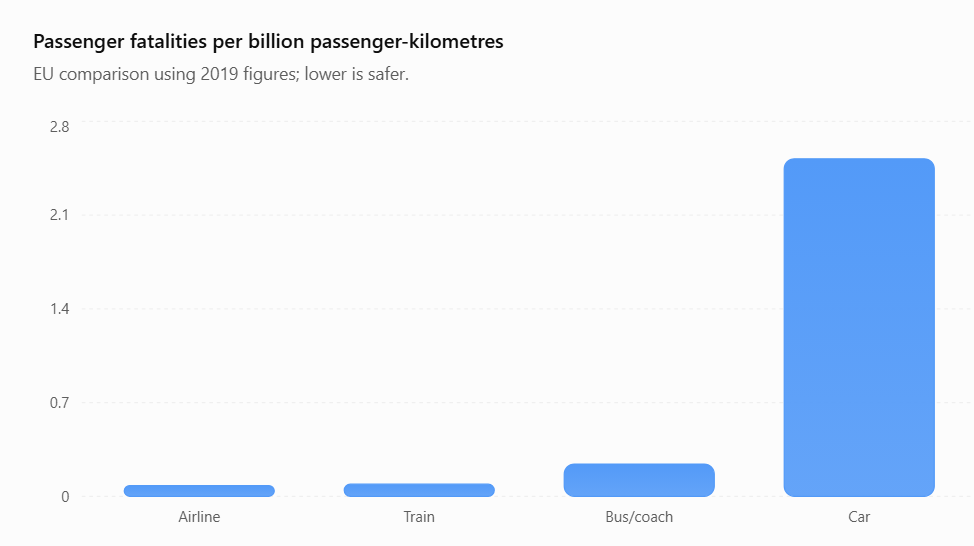
The following figures come from European transport-safety statistics.
They are useful for comparing transport modes on a common basis, although they should not be treated as exact predictions for India.
| Transport mode | Fatalities per billion passenger-km |
|---|---|
| Commercial airline | 0.08 |
| Train | 0.09 |
| Bus or coach | 0.24 |
| Car | 2.52 |
Source: European transport-safety statistics for 2019, reported by the International Railway Safety Council using European Commission/ERA data. Figures vary with the period and methodology.
What do these numbers mean?
- Airplane vs train: The rates are very similar in this dataset. The difference is too small to conclude that one is universally safer.
- Airplane vs bus: The reported bus fatality rate is 3 times the airline rate.
- Airplane vs car: The reported car fatality rate is about 31.5 times the airline rate.
These are comparisons of passenger fatality rates, not the probability of a particular journey ending in an accident.
2. What Indian data tells us
Since we are in India, the local statistics are also important.
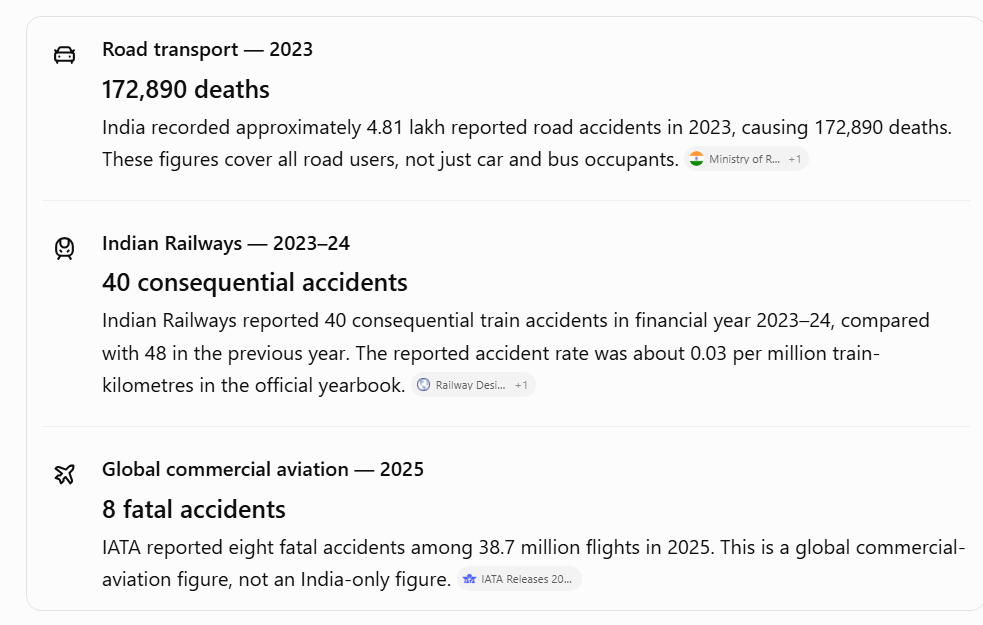
Important:
- These raw numbers cannot establish which transport mode is safest in India.
- Road statistics cover millions of road users, the railway figure counts a specific category of train accident, and aviation statistics cover flights worldwide.
- The reporting periods and exposure measures differ.
India’s Road Safety Crisis: A Number We Cannot Ignore
The question becomes even more significant in India.
- According to the Ministry of Road Transport and Highways’ Road Accidents in India 2023 report, India recorded approximately 480,583 road accidents in 2023, resulting in 172,890 deaths.
- That is an average of roughly 474 road deaths every day.
- Overspeeding was a major contributor. Reporting based on the ministry’s data attributed approximately 68% of road fatalities in 2023 to overspeeding.
- These deaths involve different categories of road users, including pedestrians, motorcyclists, car occupants and bus passengers.
- Therefore, the national death toll cannot be compared directly with airline passenger fatalities without accounting for the number of people travelling and the distances covered.
- Still, the scale of the problem makes road safety an urgent public concern.
Is flying safer than driving in India? International evidence suggests that commercial aviation has a very low fatality risk per passenger-kilometre.
- However, an accurate India-specific comparison requires consistent data covering domestic flights, trains, buses and cars over the same period.
- The lesson is not that every road journey is dangerous. It is that everyday familiarity should never be confused with statistical safety.
3. What should you choose for your next journey?
| Your priority | Practical assessment |
|---|---|
| Long-distance travel | Commercial aviation and rail are both very safe options. |
| Avoiding road traffic exposure | Flying or taking a train avoids much of the direct road-crash risk. |
| Short-distance travel | A car or bus may be more practical, but road safety depends on driver behaviour, seat belts, speed and road conditions. |
| Concern about an FQIS defect | Check the specific aircraft issue and any applicable airworthiness restrictions rather than assuming all aircraft share the same risk. |
Final verdict
- The best available comparable data here shows that commercial aviation and rail travel have very low passenger fatality rates, while car travel has a substantially higher rate in the European comparison. Buses fall between them.
- That does not mean an aircraft can never suffer a catastrophic technical failure.
- It means that the overall probability of a passenger dying is low when measured across the enormous number of journeys undertaken.
- For a fair India-specific comparison, we would need fatalities per billion passenger-kilometres for Indian domestic flights, trains, buses and cars over the same period.
- The raw accident totals alone are not enough to establish that ranking.
My conclusion
The scientifically defensible position is neither that flying is perfectly safe nor that commercial aviation is secretly unsafe.
- Flying involves a real but very low risk, and aviation safety depends on continually identifying, investigating and correcting failures.
- Accident investigations and regulatory directives are evidence that risks exist—and also that systems are in place to reduce them.
- One final distinction matters: the fact that a plane can crash proves that risk is nonzero.
- It does not, by itself, prove that flying is unsafe compared with other modes of transport.
- That comparison requires accident rates measured on a consistent basis.
What the Evidence Actually Says
So, is flying safer than driving?
The evidence supports a measured conclusion: commercial aviation has a very low accident rate, and historical European passenger-fatality comparisons show a substantially lower fatality rate per passenger-kilometre for airlines than for cars.
- However, three distinctions matter.
- First, an accident rate is not the same as a fatality rate.
- Many aviation accidents do not result in deaths.
- Second, global aviation statistics and Indian road statistics cover different populations, periods and measures. Raw totals cannot establish a fair ranking.
- Third, a low overall risk does not eliminate the possibility of an individual catastrophic accident. Aviation safety depends on continuing to identify and address technical and operational risks.
- For most travellers, the evidence does not justify treating a routine commercial flight as inherently more dangerous than a comparable road journey.
- The more useful approach is to choose reputable transport operators, follow safety instructions and evaluate risks using reliable data.
The next time you fasten your seat belt aboard an aircraft, remember this: fear is a human response, but statistics provide a way to evaluate that fear.
The real question is not whether flying is perfectly safe. It is whether we understand the risks accurately enough to make informed choices.
Sources and references
- International Air Transport Association (IATA), 2025 Annual Safety Report announcement.
- Ministry of Road Transport and Highways, Government of India, Road Accidents in India 2023.
- Indian Railways, Annual Report and Accounts 2023–24.
- US National Transportation Safety Board, TWA Flight 800 accident investigation.
- European transport-safety statistics for 2019, comparing passenger fatalities per billion passenger-kilometres.

A senior journalist with investigative skills who can promote reform by persistently drawing attention to wrongdoing and otherwise positively advancing society.