







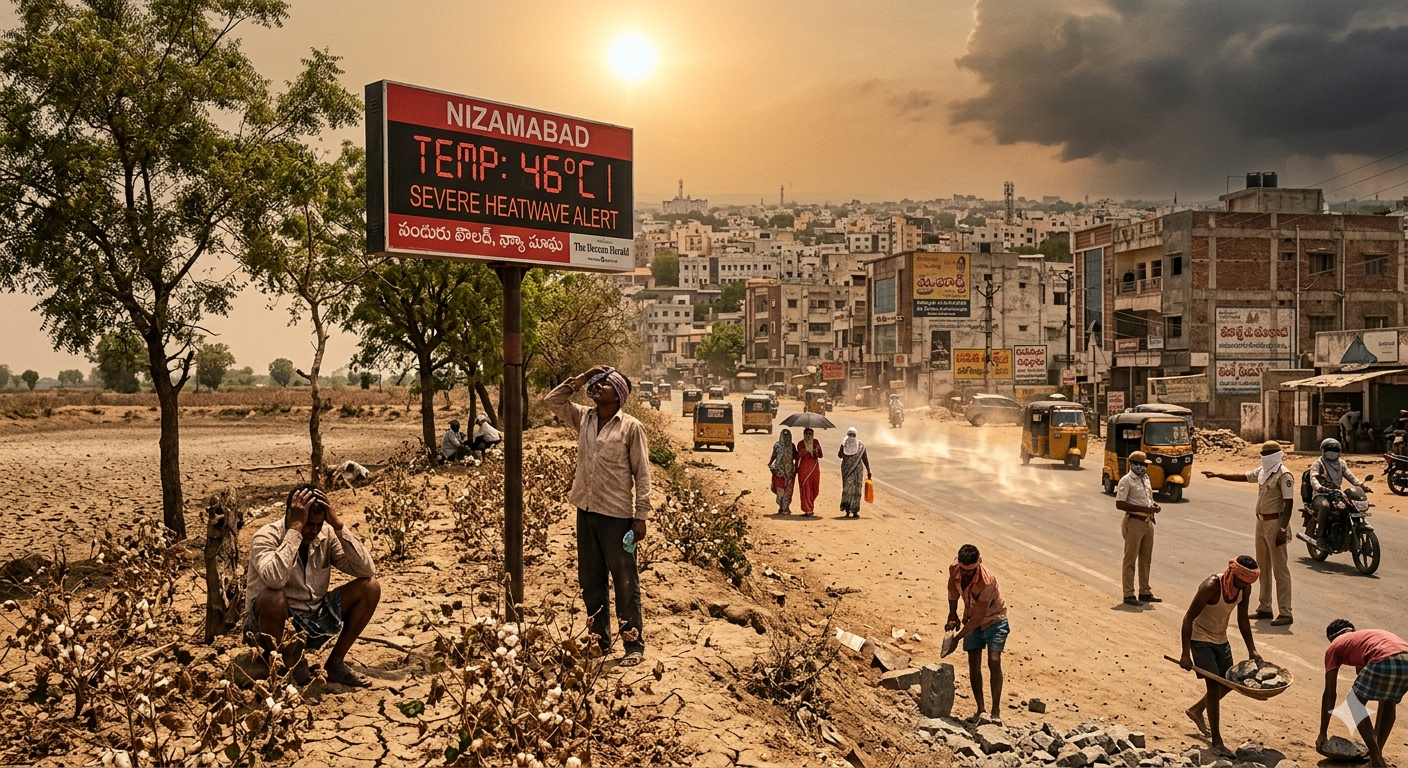
When Nizamabad touched 46°C and several districts across Telangana crossed the dangerous 45°C mark, it was easy to call it just another harsh summer.
But this is no ordinary seasonal discomfort. This is a warning—loud, visible, and increasingly impossible to ignore.
Extreme heat is no longer an exception in Telangana; it is becoming the new normal.
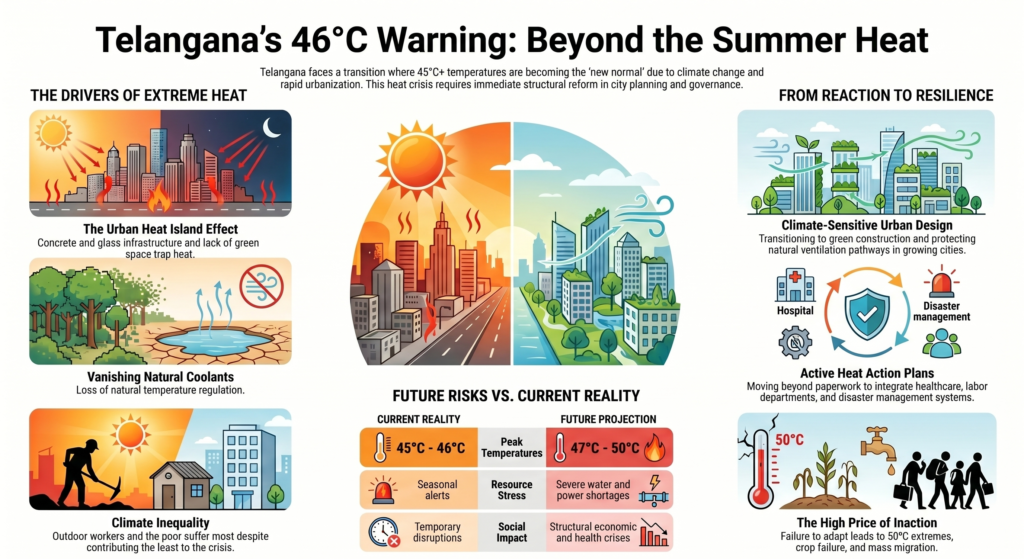
Telangana Extreme Heat Warning Infographic
The real question is not why this heatwave happened this week, but why such dangerous temperatures are becoming more frequent year after year.
The answer lies not only in weather systems, but in a combination of climate change, disappearing green cover, rapid urban expansion, poor water management, and long-term environmental neglect.
HEATWAVES ARE SYMPTOMS, NOT THE DISEASE
A heatwave is often reported like an isolated weather event, but in reality, it is the result of years of accumulated ecological stress.
Telangana, like much of India, is witnessing rising baseline temperatures. Summers are starting earlier, lasting longer, and becoming harsher. The atmosphere is holding more heat, and the land is releasing less cooling moisture.
This is not accidental.
Human-driven climate change has intensified the frequency and severity of extreme heat events.
Global warming caused by fossil fuel emissions has disrupted traditional weather patterns, weakened seasonal balance, and increased the likelihood of prolonged dry spells.
What was once considered an extreme event is now becoming a seasonal routine.
Cities Are Becoming Heat Traps
Urban growth without climate planning has made the problem worse.
Concrete roads, glass buildings, flyovers, parking lots, and expanding construction zones absorb and retain heat throughout the day. At night, instead of cooling down, cities continue radiating stored heat back into the atmosphere.
This is known as the urban heat island effect.
Hyderabad and many growing district headquarters are experiencing this rapidly.
Trees are disappearing faster than they are planted. Lakes and open land are being replaced by real estate projects. Natural ventilation pathways are blocked by dense construction.
In short, we are building hotter cities and then wondering why summers are becoming unbearable.
Vanishing Trees, Drying Lakes, Rising Temperatures
Environmental degradation has quietly removed nature’s cooling systems.
Trees provide shade, reduce land temperature, and help regulate moisture in the air. Lakes and water bodies cool surrounding regions and support groundwater recharge. But across Telangana, both are shrinking.
Illegal encroachments, shrinking forest margins, neglected lake restoration, and aggressive land conversion have reduced the landscape’s ability to fight heat naturally.
When the land dries, the air heats faster.
When lakes disappear, heat stays longer.
When forests thin, heatwaves become stronger.
This is not merely environmental loss—it is public health risk.
The Most Vulnerable Pay the Highest Price
Heatwaves are often discussed in numbers—44°C, 45°C, 46°C—but behind every number are people whose lives are directly affected.
Construction workers, farmers, delivery workers, traffic police, street vendors, sanitation staff, and daily wage laborers cannot simply “stay indoors.”
The poor face the harshest consequences.
Many homes lack proper ventilation, cooling systems, or reliable electricity. Access to drinking water is unequal. Heatstroke treatment is often delayed. Livelihoods are interrupted by extreme afternoons.
Climate inequality is becoming one of the most dangerous social realities.
Those who contributed the least to the crisis are suffering the most from it.
The Future Could Be Worse
If present trends continue, Telangana may face far more than uncomfortable summers.
Future risks include:
- More frequent 47°C to 50°C temperature events
- Severe water shortages in both urban and rural areas
- Crop failures and reduced agricultural productivity
- Rising electricity demand and power stress
- Increased heat-related illnesses and deaths
- School and work disruptions during peak summer months
- Migration from drought-prone and heat-stressed regions
- Greater economic burden on poor and middle-class families
Heat will no longer be a seasonal issue—it could become a structural crisis affecting health, economy, education, and social stability.
This Is Also a Governance Question
Heatwaves should not be treated only as weather reports.
They are policy failures.
Urban planning without green design, delayed environmental regulation, weak water conservation, poor public transport, and inadequate climate adaptation strategies all contribute to the crisis.
Plantation drives alone are not enough if mature trees continue to disappear.
Heat action plans cannot remain paperwork; they must become functioning public systems involving healthcare, schools, labor departments, municipalities, and disaster management authorities. Preparedness must replace reaction.
What Needs to Change Now
The response must be immediate and long-term.
Critical priorities include:
- Protecting and restoring lakes, forests, and urban green cover
- Climate-sensitive city planning and construction regulation
- Expanding shaded public spaces and cooling shelters
- Strengthening heat action plans at district level
- Better public health systems for heat emergencies
- Sustainable groundwater and drinking water management
- Public awareness campaigns beyond temporary alerts
- Stronger climate accountability in governance
The solution is not simply surviving summer.
It is redesigning how we live with climate reality.
A 46°C Day Should Not Be Normal
When a district reaches 46°C, the story should not end with a weather update.
It should begin with a larger conversation.
Because this heat is not just from the sun—it is also from policy neglect, ecological damage, and years of postponed responsibility.
The warning is clear.
The question is whether we will respond before 46°C becomes ordinary, and 50°C becomes the next headline.
By then, survival itself may become the biggest development issue of all.